
TAMING THE PLAINS
#149 - a band of young Cheyenne warriors lined up on the hill crest and fired down on Will’s place. Both he and Anna fired back, prepared for further action. The Indians disappeared behind the rise.

Welcome to Before I Forget . .
I’m glad you are here. Thank you for your time.

TAMING THE PLAINS
He was shot during the battle at Appomattox, just before Lee’s surrender.
The bullet was still in his thigh. Doctors said it was embedded in the femur and next to the femoral artery. Trying to remove it was deemed more dangerous than leaving it in place. Just watch for infection.
That was almost three months ago.
His leg healed, leaving him with a souvenir from a rebel soldier and a limp. His limp lessened with time.
He had volunteered for the U. S. Military Telegraph Corp. The Union Army had put out an urgent call for telegraph operators.
Western Union found an operator to replace him until his return.
Anna, of course, was against him going but could see what it meant to Will. And he had a skill that was needed. He believed the war would end soon.
The volunteers would be non-uniformed civilians, working at the front lines.
As well as repairing existing pole-lines cut down by the rebels, they laid out wire from the command post telegraph to the front from spools hung on battery-wagons and mules across ground, bush, and fence following troops as battle unfolded.
Operators “hooked up their instruments,” and telegraphed real-time action info back and forth from the officers in the field and the command post.
The nearly instantaneous telegraph communication changed warfare.
Their casualty rate was the same as the soldiers, about ten per cent.
He rehabbed in a field hospital near Appomattox.
On Will’s return home, he detoured to Ohio, to Sistersville, his home before moving west. His father’s parents and two sisters plus their families were fine, as were his mother’s mother, and brother.
Will had written them of the fever that took the lives of his parents and sister while he was with the Pony Express.
They grieved together over their family loss.
He told them about his family. Anna, his first-born twins, Will Jr. and Caroline, now four years old, Randolph, three, and Susannah, one.
And in the cemetery back home, there was another grave, a son that died at birth.
He looked up old friends. Many had moved away.

Home now for a month, and back at work at the telegraph in Ft. Kearney, family and friends celebrated Independence Day, the end of the war, and Will’s return.
The region had gained many settlers, a result of the 1862 Homestead Act. They all wanted the same thing as Will did, their own land, to work it and raise their families.
With his stable telegraph job and good crop yields over four years, Will purchased the acreage he had wanted. Nearly 700 contiguous acres, stretching northwest to southeast. The price of land was rising fast. People were moving in.
The southeastern corner butted up to Gustafsson’s spread. He bought up to or around existing homesteads. He bought out a couple of families who wanted or had to move on.
He and Anna partnered with Hugo and Mr. Gustafsson, Anna’s brother and father. They took on the growing of the crops. Between them, they had 200 acres planted.
Anna took naturally to doing the paperwork and generally kept things in order.
Will wanted to leave the Telegraph and begin raising cattle, maybe sheep. He lacked the number of acres needed for a large cattle presence. The open range days for cattle were coming to an end with the influx of people and fencing.
Cattle was the staple, but he would have more options with sheep and that appealed to him.
They could manage sheep, and even goats and hogs, at what appeared to Anna’s number-crunching as a lot easier and, more profitable.
They would make those decisions when the time came.
Nebraska’s populace grew, and became a state in March, 1867.
Will’s days were long at the office in Fort K. But worth it in his estimation.
Up early, buggy-ride the forty minutes to the office, work, buggy-ride home or stay over. Sundays off.
He was tiring of it. He was set up financially enough to make a go of it, and he wanted to work his land.
Two things pressed Will into wanting to be home on the farm.
In ‘67, a huge buffalo herd migrating north for the summer, trampled through half of their wheat and corn fields, tearing down fencing as they moved.
It’s path of destruction looked like a tornado came through.
It was a financial hit. Some neighbors lost their whole year’s produce. The Gustafsson’s spread was missed entirely.
It was only Hugo’s repeated rifle firing and taking out four of the slow-moving mass did the herd turn by degrees and miss the rest of the crops. Perhaps even the house, and barns.
Anna and the kids and Mr. Gustafsson were at the wagon, ready to go if they needed to leave.
The buffalo gave little heed to the wheat or corn, they wanted the next swath of fresh prairie grass. The crops and fences were just in the way.
Hugo, shooting from his mule, could have been killed.
Then the Lakota Sioux and Cheyenne Indians were war mongering again. Red Cloud’s war.
There were skirmishes with the army and settlers, and the railroad.
A few miles east of Fort Kearney, at the Campbell place, a woman was killed and Campbell’s two daughters and twin sons were kidnapped.
Will needed to be at home full time.
He was grateful for his job with Western Union but it was time to go. He gave them notice that he would be leaving.

There was one time when a band of young Cheyenne warriors lined up on the hill crest and fired down on Will’s place. Both he and Anna fired back, prepared for further action. The Indians disappeared behind the rise.
Most of the harassment was further west up the Platte into Wyoming and Montana.
Red Cloud won this war with a treaty at Fort Laramie in 1868. Many thought it to be a temporary peace at best.
Will and family turned their attention to their future. They would keep a small number of cows, but sheep would be their main concern.
He built a shelter and corral near the house large enough to house a hundred sheep. Hopefully, he would have to expand it. His first herd of twenty-five sheep were on the way from St. Louis. Fifteen Merino and ten Cotswold.
He bought two donkeys as guardians. They would be with the sheep always. Good against coyotes, but wolves, probably not.
He would have to get a guard dog, a Great Pyrenees, or an Anatolian sheepdog. They weren’t easy to find on the prairie, and sheep were not yet raised in large numbers needing such guarding.
Will would have to be the guard and herder day and night.
He built a small room in the shelter with a pot-belly stove. He and Will, Jr., would stay the night there. “Willie” was seven years old now, (“Seven and a half,” Willie would say.) and it was great adventure being with his father.
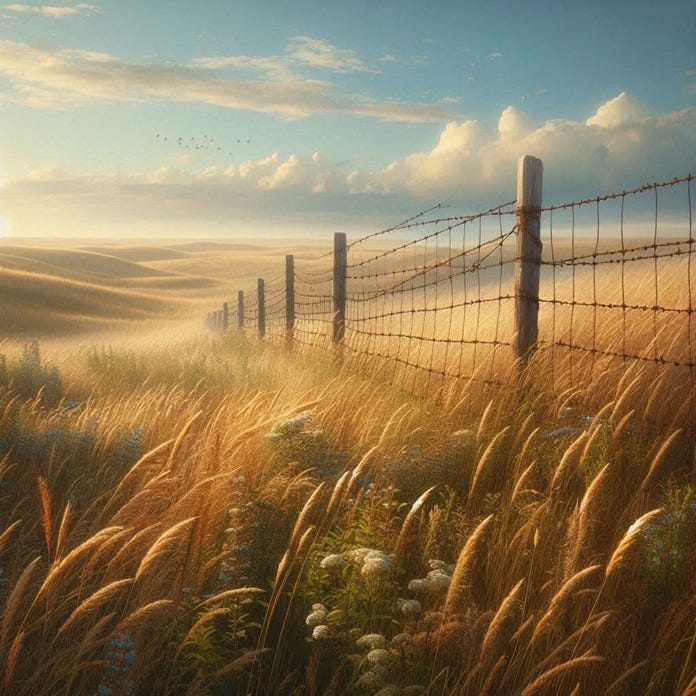
Around the shelter, he and Willie fenced off a hundred acres, to be divided into four paddocks.
That way, Will could rotate the herd into fresh grass easily and often. Being fenced in, they wouldn’t need to be herded continually.
Fence wire was expensive, and the new barbed wire was much more so.
Much of the work during this time was done in sadness as Anna had miscarried. They were heartsick.
Caroline, “Carrie,” was a great source of help and comfort to her mother. Like Willie, she was growing up. Kids grew up fast on the plains.
There was another gravestone in the cemetery.
The completion of the Transcontinental Railroad in ‘69 began the demise of Fort Kearney. It bypassed the fort. The shift from wagon train-based transport to rail made it functionally obsolete. Soldiers were moved to other locations as needed.
It was no longer the hub of activity it once was. It now served only the local area.
Months passed, the fencing was done and the second set twenty-five sheep were on the way. Will and Willie were sheep herders.
Anna and Carrie were back to being their naturally happy selves and in October 1869, a second set of twins joined the Shaw family. Anna Belle and Anna Lee.



Thank you for reading Before I Forget . . !
For my new Subscribers - a post from May 19, 2023,
Return To Stardust

#47 - It was unlikely that Major Tom would reenter the atmosphere where he would then burn up as he fell to Earth.
Image by DALL-E 3
"Kids grew up fast on the plains." Today, many kids never grow up!
You packed a lot into this story. I know you've got plenty to do, but I'd love to see this stretched out into multiple chapters. Just saying.
Wonderful Americana that is not taught in schools and it should. Our country would be better for it.