
A BIG BANG
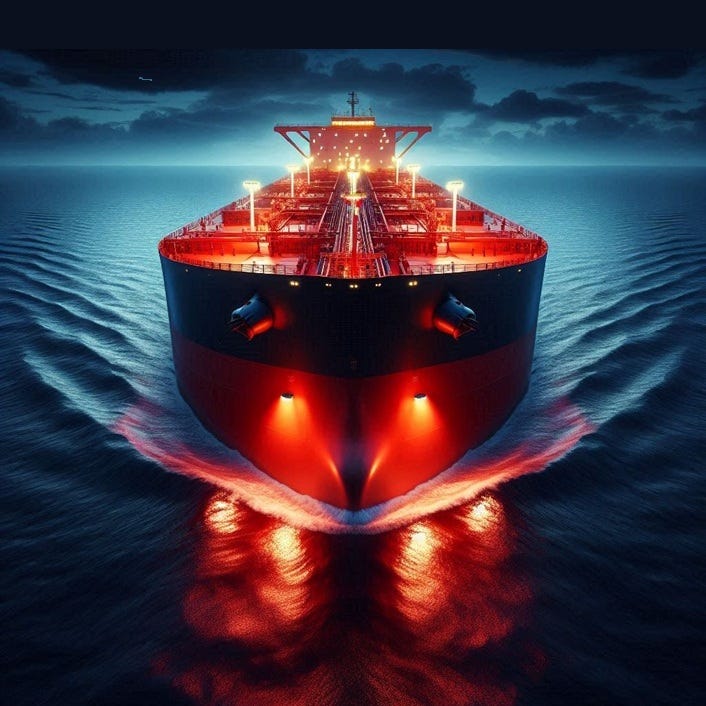
#148 - The deck lights were on; those on poles along the guard rails blinked red on and off. The superstructure was lit up. It looked like some red and black behemoth bearing down on its prey.

Welcome to Before I Forget . .
I’m glad you are here. Thank you for your time.

A BIG BANG
The road used to go through to Port Costa, a once-upon-a-time rowdy refueling stop for the steamships that navigated up and down the rivers.
Oaks, bay laurel, buckeye, and eucalyptus come down thick on the winding road, then open up to treeless hillsides now green and teeming with broad swaths of blooming mustard plant.
A section of steep hillside upon which the road runs, collapsed, again, taking out the road. A foot and bicycle only asphalt trail connects both sides.
It won’t be repaired this time. It is part of the Parks and Recreation.
He was parked at an overlook before the closure that looks east, taking in the towns of Martinez on the south side of the Strait, and Benicia on the north.
Amtrak’s California Zephyr came into view. He was about a hundred feet above and two hundred feet from the tracks.
Above the train, the angle was such that he couldn’t see through its windows to get an idea of how many people were on board.
The Zephyr’s nine shiny new cars rolled slowly into Martinez, a mile away and beyond a curve.
It passed alongside several sets of tracks. Sidings for rolling stock. Thirteen oil tankers in a ‘hold’ position waited for an engine and a destination.
Barely above the tides, the tracks parallel the waters of the Carquinez Strait, and then the Bay, on its way to Oakland.
He heard the train whistle as it pulled into the station. Only a couple of minutes later, it sounded again as it departed.
In minutes, the train appeared on the southern end of the mile and a half trestle, heading across the Strait to Benicia and all points east.
The trestle is about half the height of and runs along the two bridges that make up the Benicia Bridge. Each four and five lane bridge is devoted to one direction only. It gets a lot of traffic.
Rainstorms had cleared, but in the light winds, low broken fog clouds rose and fell with the air currents. It blew in from above and below, obscuring all or most from view one moment, then opening up to blue sky in another. It was quite nice actually.
The train disappeared into a blanket of fog midway across, its multi-fingered mass spreading south.
The lift bridge section of the trestle began to rise. A ship is coming.
It rises to the height of the bridges.
He was better than a mile from the bridges but could see it was a tanker coming, riding low in the water, the smokestack smoking, the hull painted red and black.
It was yet a few minutes away from the lift, already lined up for the channel.
Beyond the bridges on a clear day like today, the huge wind turbine farm twenty miles away is visible and on a very clear day, the snow-capped Sierra Mountains, a hundred miles distant.
As the bow of the ship powered under the trestle, the engulfing fog closed in. Only the southern end of the bridges were left in the sun. And that wouldn’t be for long; the fog bank was on the move.
The ship reemerged with the feint but growing shape of the tanker plowing through the fog.
The deck lights were on; those on poles along the guard rails blinked red on and off. The superstructure was lit up. It looked like some red and black behemoth bearing down on its prey.
It was then that he saw no smoke from the stacks.
What was happening? It should be turning starboard. The ship kept coming straight at him on a line taking it out of the channel.
It ran over a channel buoy.
It was dead in the water. Moving only on its momentum and the current.
Its line would bring it ashore right below him.
He stared at it, mesmerized.
Only when he heard the ship’s horn, repeatedly blaring “S-O-S,” and it neared the remaining pilings of the old wharf did he snap out of it. The pilings wouldn’t stop its coming ashore and up on the tanker cars on the siding.
He started the car, rolling up the window as he gunned it out of the overlook.
He felt, rather than heard, its meeting the shore. Like an earthquake.
A momentary stillness then in quick succession, a blast force rocked the car almost pushing him off the road, a blinding flash of red and orange lit up the surroundings, and a thunderous explosion followed close behind.
The driver-side windows cracked. The air smelled of scorched earth and something pungent, acrid. His face felt hot.
Then another explosion, and another, and two more. The oil cars were blowing up.
The road wouldn’t allow for much speed with its many curves. Seconds took an eternity; he couldn’t get away fast enough.
Minutes later, he was in town.
He expected to see alarmed people running around. They had to have heard the explosions. They were only a mile away.
Kids on e-bikes and scooters, couples walking, drivers cruising town on a quiet Sunday afternoon. And no looks of concern on their faces.
Except for one couple staring at him as he drove by.
He neared the brewery at Escobar and Estudillo. Customers sat at tables out on the patio. He pulled over in the red zone and got out yelling, “Didn’t you hear the ship explosion? It ran aground at the railroad sidings!”
Alarmed, they stared at him, and his car. Some went to their cells looking for notifications, or other news.
He appeared to them disheveled and bewildered. Perhaps in shock.
They called the police and fire department for info and help.
One fellow got up, giving up his chair to him. People inside saw the action outside, got up and rushed about. The band stopped playing in the middle of “Hotel California.”
Some left in a hurry upon hearing the news and scared from seeing him and his car.
A waitress brought him a cold brew.
“What happened,” they asked?
While repeating his story, he saw what others saw of his car. Along with the cracked windows, paint was gone, down to the metal in spots. Dripping and bubbled blue paint across the whole side. As if blowtorched.
He went quiet, eyes blinking. He shook his head.
“Are you okay, man?”
“I feel fine. The side of my face is hot.” It looked like a bad sunburn.
“What’s your name?”
“William.”
“Where do you live, William?”
“In Concord. By the airfield.”
“Did you call your family?”
“I live alone.”
The paramedics arrived followed by the police.
He repeated his story while the paramedics checked him out. They wanted to give him fluids but he refused. They put a gel salve on his face.
The police ran their ID check on him.
They said nothing was amiss. No explosions. No fire on the hillside. The Harbor Master reported that the tanker, “Panama Red,” had passed under the bridges safely a half hour earlier and was nearing Osprey Point and Port Costa.
“What happened, man?”
He felt faint. His fingers touched his face. What if he hadn’t rolled up the window? He looked at his car.
“I don’t know.”


Thank you for reading Before I Forget . . !
For my new Subscribers - a post from May 5, 2023,

Image by DALL-E 3
Well, I'm happy to hear this was not a true story about one of your experiences, James. But that just makes it all the more impressive. The detail in the description of events makes it sound authentic. The action is terrific. Nice twist at the end. I became suspicious when the townspeople had not reacted. What did happen?
Holy cow, Ron! I hope you have a part two for this - and make it quick! Shocking! You must have witnessed something like this, otherwise you could not have made it so vivid.