
THE GOLDEN SLIDE
#26rp - On the last stage, we ran the tub over a ground hornets’ nest. James was stung multiple times as he escaped back up the rope. He had nowhere to run. It could have been worse.

Welcome to Before I Forget . .
I’m glad you are here. Thank you for your time.

THE GOLDEN SLIDE
I don’t sleep well the night before going up to the gold country. I’m restless and usually up before the alarm. Seems I would be used to it by now but once bitten by the gold bug, the fever’s hard to break.
I think the other guys are the same. The gold is good, but getting out of the city and into nature with friends is pretty good also. The exercise itself leaves me pretty much worn out and with a good wholesome feeling at the end of the day.
Depending on who is going up and where we live determines whether we can carpool or drive up separately. We are spread out.
Any combination of us going up together usually makes for good talk. Politics, and “Where’s the gold?” are the main topics.
“Gold is where you find it,” it is said. And it is true. On the bedrock, behind big boulders in the river that create eddies behind them where the heavier gold can drop, and in the roots of riverbank bushes. And in the rolling hills down to the flatlands. And sometimes where you would least expect it.
Over the eons, the prehistoric rivers that flowed north from South America through the North American west, were disrupted by the Rocky Mountain/Sierra buildup. The land and the gold veins within, were upturned, folded, tilted, and turned askew. Rivers had to find new routes, and their courses changed, especially in the Sierra, to a westward flow down the slope of the mountains to the ocean.
These rivers cut through gold veins eroding them as they flowed; they deposited the gold all along the river. This gold is flatter and smoothly rounded.
Some gold has eroded from hillside outcrops exposed to the elements and has moved downslope. It is usually chunky and angular.
This is placer gold, found near the surface or in rivers. These can be sizable nuggets, down to “pickers” - what you can pick up with your fingers, and down to small stuff and gold dust you can barely see.
In Carlin, Nevada, hugely profitable and one of the largest open-pit and underground mines extracts gold that can’t be seen with the naked eye. Large bulldozers and dump trucks operate day and night moving tons upon tons of ore for processing. Underground, dozers and haulers traverse wide tunnels doing the same. The gold is smelted and refined into gold bars onsite.
The smaller stuff is your bread and butter. It is much more common, and it adds up.
The “easy pickings of the old days” are no more. It is physically demanding. Especially for small claims miners – like us.
Whether on dry ground or underwater, moving the unending supply of rock and dirt to get the gold is the name of the game. Using your hands, picks, shovels, and a come-along gets it done.
Heavier digging equipment is highly regulated and costly.
Lode mining is the digging of underground tunnels prospecting or following the gold veins. More lucrative perhaps, but costly to pursue.
The Empire Mine, started in 1850, in Grass Valley, Ca., is one of the richest hard rock mines ever. At its closure in 1956, it had produced 165 tons of gold. It has over 350 miles of tunnels reaching a depth of over 2 miles. The amount of labor involved is mind-boggling but is a testament to the efforts taken to get the gold.
Every year, the riverscape changes. The spring snowmelt runoff can scour the brush from the riverbanks. The force of the water can unearth gold that has been settled for who knows how long and move it downstream. And it moves sizable boulders. To hear these boulders roll on the river bottom during a strong runoff is impressive. You can feel it and it sounds like muffled thunder.
Every year, the hole we worked the previous summer is refilled over winter with river sand and a fresh supply of rock of all sizes. Hopefully new gold has found its way in also.
So, we are always trying to figure out where the gold is. We have a few claims that we prospect but settle in on one for the summer.
The Golden Slide has been the most productive, and we get busy when the river gets low, and slow, enough to get the equipment in. This is usually from late June, until the rains start, usually in November, and the river rises again.
The heavier gold is usually in the deeper channels of the river. We mine it when the water is lower. When the river is high, the banks get the lighter gold, the flood gold. But there are plenty of exceptions. Gold is where you find it.
We dredge for gold. We use a vacuum pump and hoses to suck up material from the river bottom. From either a floating device or from the riverbank.
Dredging is illegal in California because of the perceived pollution and concocted reasoning of our politicians and environmentalists. It is patently untrue.
Modern-day prospectors do more to clean up the rivers than any of their rules and policies.
So, we respectfully participate in civil disobedience along with many county sheriffs who look the other way knowing the importance of our money contributions to their rural communities.
Besides, they can’t find us. The politicians and environmentalists are only good at legislating what we can and can’t do.
We are off to a late start this year. It is now mid-August. We had a lot of snow last winter and a slow snowmelt because of the cool spring.
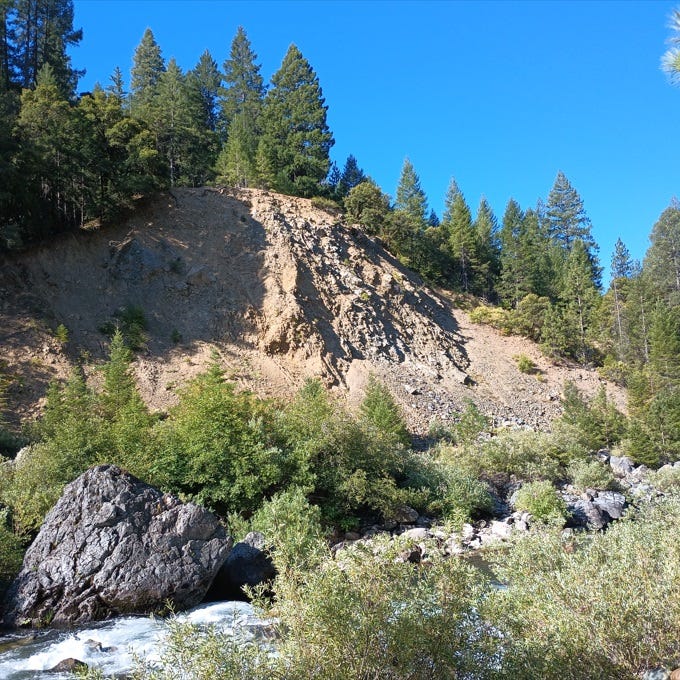
But now it’s go-time. We’re going to be on the opposite bank from last year’s diggings which is at the bottom of The Slide and is now unstable. We had worked ourselves into the steep bank as that was where the gold was leading us. It’s not safe.
We usually load our equipment on pontoons and pull it upriver from our campsite to the worksite. Now, the current is still too swift. We must carry our gear overland to the new site. We can get pretty close to the site as there is a road above the other side.
It is over 100’ down (it looks and feels like more) a steep forested poison oak covered slope from the roadway to the river. We need ropes to help us get down, and back up. There is no sure footing. Slow is the only way to go.
On this day, there are three of us. Joe, James, and me. And we aren’t young. We should probably quit all this, but we aren’t quite ready yet. So, on old legs and with bad knees, hips, backs, and shoulders, we start moving the equipment down. We laugh at ourselves a lot.
We have a pump, sluice box, nozzle, and suction hoses of different lengths and widths, buckets, hand tools, and our backpacks. All of it is heavy, awkward to carry, or both.
We tie it down in a big mortar tub a couple of pieces at a time, or more if room allows, and slide it down by rope to the next stage. And repeat.
We can’t afford to drop or overturn the tub. The pump could easily break. Or the gear could tumble into an unreachable spot down the slope. We have four stages down to the river. It takes us two hours to make it down.
On the last stage, we ran the tub over a ground hornets’ nest. James was stung multiple times as he escaped back up the rope. He had nowhere to run. It could have been worse.
We set up the gear at the site and were almost ready to begin when we discovered that an adapter connector for the main hose had been left at home. Ha! LOL!—The joke’s on us! All comes to a stop.
Oh, well, at least the hard part is done for the next time we come up. We dismantled everything and stowed it back in the bushes. We got out our hand tools and panned on the riverbank for a while. Then we called it a day. We had a long drive home after we pulled ourselves back up the hill using the ropes.
I can remember when such a thing might just irritate me to no end. But now, I’ll fondly remember this for a long time. I was still out of the city, in a beautiful place, with friends.

This story was first published on Aug. 18, 2023.


Thank you for reading Before I Forget . . !
For my new Subscribers - a post from Sept. 8, 2023.

Image by Me
This whole process sounds slow and exhausting, especially for you old guys! But I can definitely see the attraction. Such an adventure! Out of curiosity, Ron, about how much money have you made on the bits of gold you've found over the years? Hope you don't mind my asking. I know it is worth the effort just to get out of the city and get some exercise, but what about profit?
Thanks for the lesson in prospecting. It was a fun read. Reminds me a little of Jack London.